Reimagining the House: The Wyoming Rule
How proportional representation would reshape the US House of Representatives using the smallest state as a baseline.
The United States House of Representatives was originally designed to grow alongside the country’s population, ensuring proportional representation for all citizens. However, the Reapportionment Act of 1929 capped the total number of representatives at 435. As a result, the population variance between districts has grown massive, with citizens in smaller states often holding disproportionately more voting power per capita than those in larger states.
One proposed solution to this imbalance is the Wyoming Rule.
Under the Wyoming Rule, the standard size of a congressional district would be determined by the population of the smallest state in the union (currently Wyoming, with a 2020 census population of roughly 576,000). Every other state would then receive a number of representatives proportional to how many “Wyomings” fit into their population.
If we applied the Wyoming Rule based on the 2020 Census data, the size of the House of Representatives would expand significantly to ensure equal representation:
- California would see its delegation explode from 52 to 69 districts, gaining the most absolute voting power.
- Texas would jump from 38 to 51 districts.
- Florida and New York would rise to 37 and 35 districts, respectively.
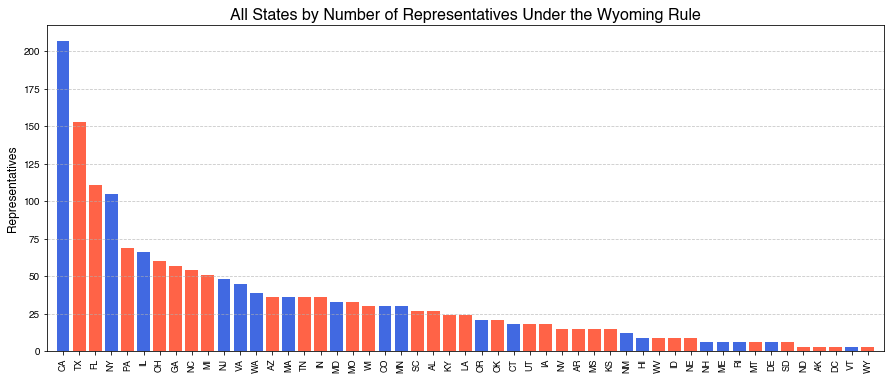
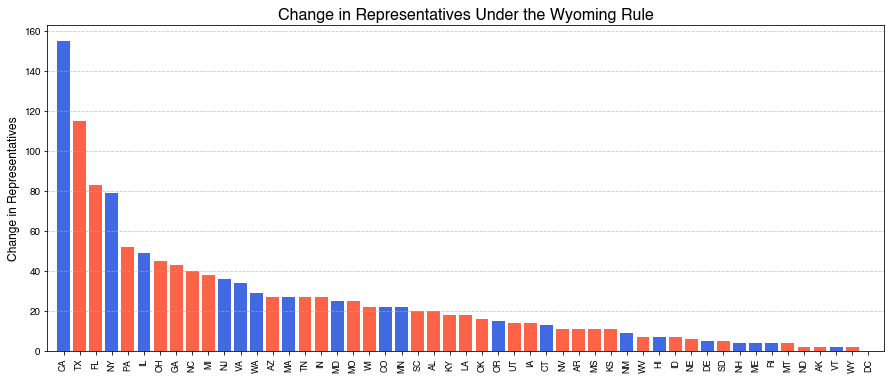
Overall, implementing the Wyoming Rule would add over 130 new seats to the House. While smaller states would retain their minimum constitutional representation, the influence of the most populous states would scale linearly, restoring the mathematical equity that the founders originally envisioned for the lower chamber.
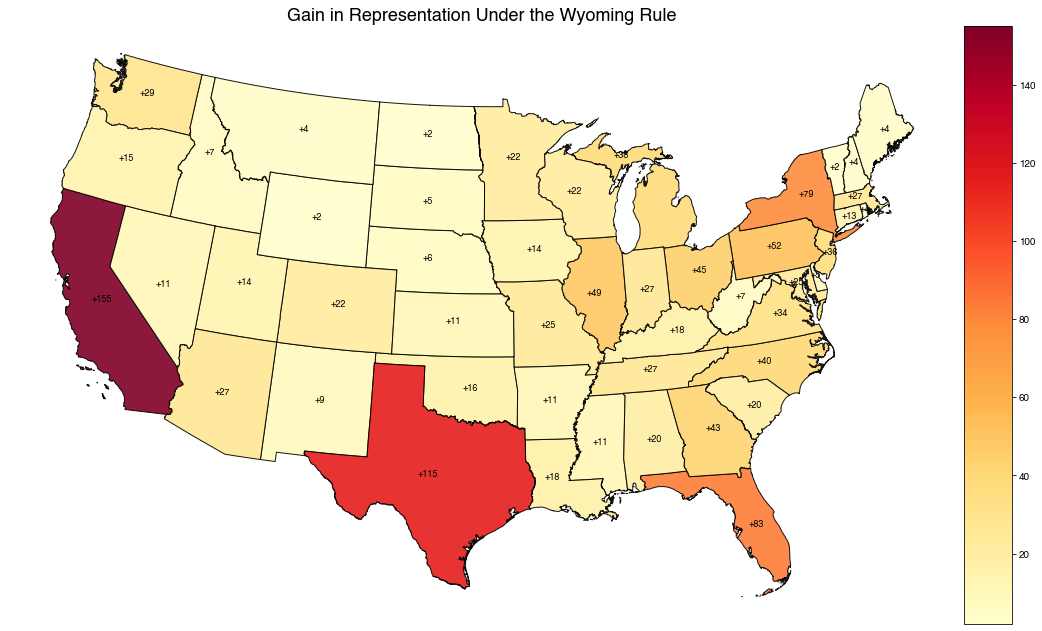
Data sourced from the 2020 US Census.